Businesses in ChatGPT: What It Means for Martial Arts and Dance Studios
TL;DR: OpenAI opened Businesses in ChatGPT in beta on November 10, 2026 — a free way for a business to claim a profile inside ChatGPT, correct the facts ChatGPT has about it, and see how often it gets mentioned. For a martial arts or dance studio, the value is simple: when a parent asks ChatGPT for a studio in your town, the answer should name you and get your programs, ages, and hours right. Claim it, correct it, and make your own website the source that answer is built from.
Most Studio Owners Already Have a Profile in ChatGPT They’ve Never Seen
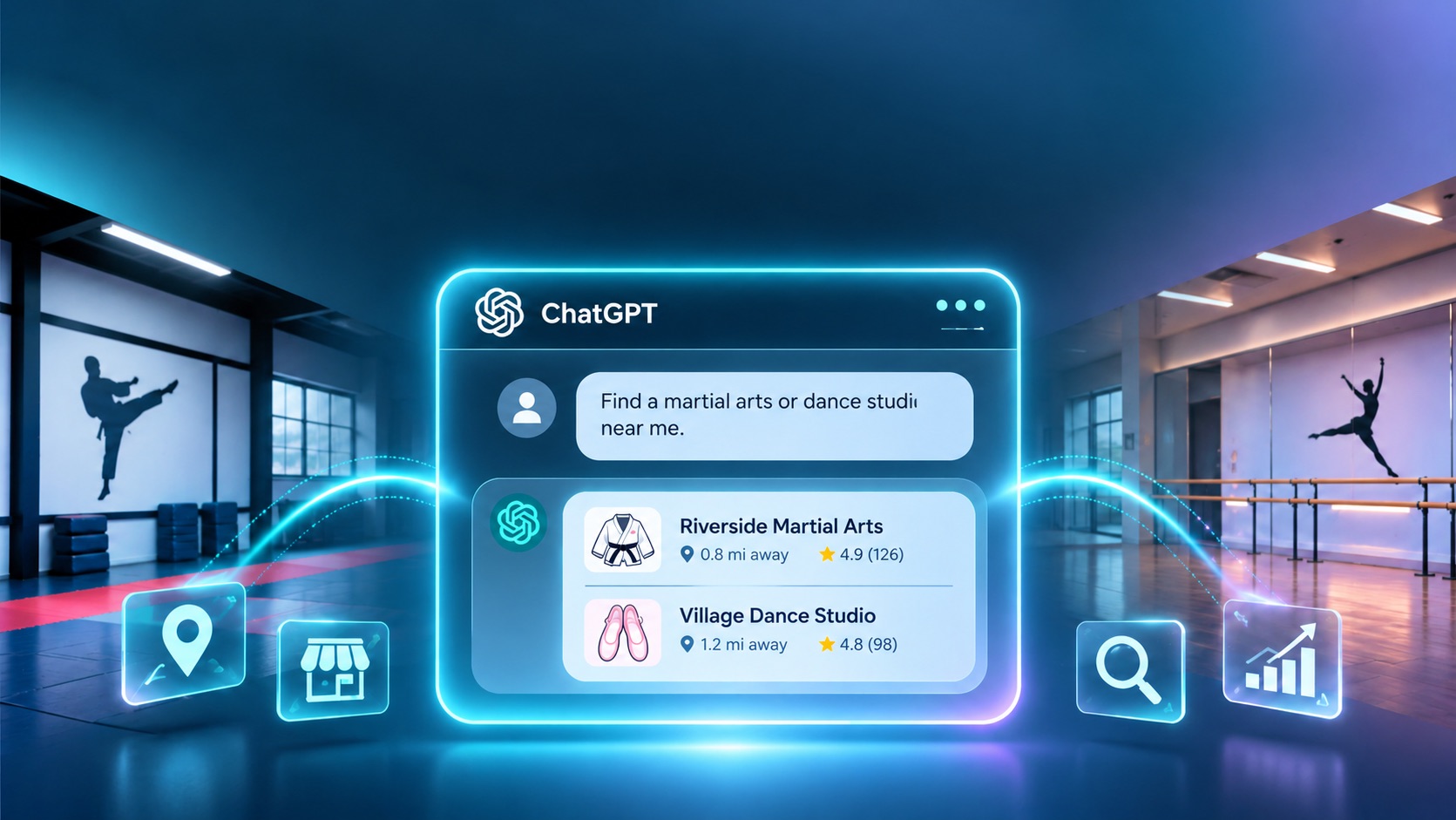
Open ChatGPT and ask it to recommend a martial arts school or dance studio for a five-year-old in your town. You will get a short list — and there is a decent chance your studio is on it, described with details you never typed anywhere yourself.
Until last week, that was the whole story. You had no idea what ChatGPT was telling parents about you, no way to fix an outdated schedule, and no way to make sure it knew you cap classes at twelve kids or that your adult beginner program exists at all.
That changed on November 10, 2026, when OpenAI launched Businesses in ChatGPT in beta. It is the first time a studio owner can walk into ChatGPT, claim their own business, and take responsibility for what the answer says. Think of it as a second Google Business Profile — except this one feeds an assistant that writes a paragraph about you instead of showing a map pin.
Why Now, and Why It Isn’t a Gimmick
The announcement was easy to skim past because it sounds like an ads product. It isn’t only that. ChatGPT is now where a growing share of families do their first round of research — “what’s a good dance studio near me,” “is taekwondo good for a shy kid,” “how much do ballet classes cost.” Those are the same questions parents used to type into Google, and the answers now come back as sentences with a name attached.
If your name isn’t in those sentences, you’re not competing on price or schedule. You’re absent from the conversation.
Key points for studio owners to consider:
- Businesses in ChatGPT is a free business profile inside ChatGPT, managed from a dashboard called Business Hub.
- Claiming is different from advertising. It doesn’t buy you placement, and OpenAI says claiming doesn’t guarantee higher placement or sales.
- The profile holds your facts — website, description, category, logo, hours, and service details — and ChatGPT may use them when answering questions about you.
- Insights show mentions, website clicks, and “discovery topics” — the themes in conversations where your business came up.
- Business Agents are limited for now to eligible ecommerce and online service businesses in the U.S., and they can’t book a trial or take payment for you.
- Local businesses can currently claim only an existing U.S. listing, so your first move is checking whether you already appear.
- Your website is still the source of truth. The profile corrects the facts; your site is what earns the citation.
What Is Businesses in ChatGPT?
It is a profile for your business that lives inside ChatGPT, plus a dashboard behind it. Customers see the profile when they click your business in an answer. You see the controls in Business Hub, where you claim the listing, prove you’re authorized to manage it, and publish updates.
The setup runs in three layers:
- Claim and verify. You find your business by name in Business Hub and verify with a business phone number, a business email address, a TXT record on your domain, or a connected Shopify store. OpenAI reviews the claim.
- Verify your identity. A separate identity check through Persona unlocks the ability to publish changes, view insights, and create an agent. The blue check on your profile appears only after this step is approved.
- Publish your details. Once approved, you can update your website, business description, service category, logo, cover photo, and policies.
What You Can Control
The fields are unglamorous and that’s the point: website, description, category, logo, photos. For a studio, that means you can finally state plainly that you teach Brazilian jiu-jitsu for adults, ballet for ages three to six, or competition team by audition — in the place an AI assistant reads.
OpenAI reviews and publishes changes, and updates can take time to appear. ChatGPT may also rely on other sources, so the profile shapes the answer without owning it.
What You Can See: Mentions, Clicks, and Discovery Topics
Business Hub reports three things over a rolling 28-day window: mentions, website clicks, and discovery topics.
For an online business, a mention counts when ChatGPT references your website — your name alone doesn’t count. For a local business, it counts when ChatGPT shows a result for your location, even if nobody opens it. Discovery topics are the themes in answers that mentioned you, which is the closest thing to seeing what parents ask before they call.
Everything is aggregated. You don’t get individual prompts or conversation transcripts, and blank metrics can simply mean the volume hasn’t hit OpenAI’s reporting threshold yet.
What a Business Agent Does — and Doesn’t Do
A Business Agent is a chat layer on your profile that answers customer questions from information you supply and guidelines you write. Someone comparing two programs can ask follow-ups and get an answer grounded in your material instead of a guess.
Two limits matter. First, agents are currently open to eligible ecommerce and online service businesses in the U.S., so a brick-and-mortar studio may not qualify yet. Second, an agent cannot complete purchases, make bookings, or check an account — it explains and links, and the visitor finishes on your website.
Why This Matters More Than Another Directory Listing
Directory listings put your name next to twenty others. ChatGPT answers with a paragraph, and that paragraph does the shortlisting for the parent.
OpenAI framed the launch as a way to connect with the 1.2 billion people who use ChatGPT each week. You don’t need to believe every one of them is shopping for swim lessons to see the pattern: families have moved part of their research into a chat box, and the chat box now pulls business details from a record you can edit.
There’s also a self-interest argument that has nothing to do with new leads. If ChatGPT has your old schedule, a closed location, or the wrong age range for your toddler class, you’re being described inaccurately to exactly the people deciding whether to call. Fixing that costs an afternoon.
This is also where answer engine optimization stops being abstract. A claimed profile is the floor. Being the studio an answer is built from is the ceiling — and that comes from clear, specific, well-structured content on a site you control.
How It Can Benefit a Martial Arts or Dance Studio
The benefits aren’t exotic. They’re the same things a good Google Business Profile does for you, applied to a channel where the answer is written in sentences instead of ranked in a list — with one addition: you can see the themes behind the questions.
1. Your Facts Replace Someone Else’s Facts
Most incorrect information about a studio comes from the same handful of places: a scraped directory, a stale Facebook page, a schedule PDF from two seasons ago. A parent who reads “ages 4 and up” from an old source and arrives with a three-year-old has a bad first visit that you never got to prevent.
A claimed profile gives you one place to state the current version — and a verification badge that separates your input from scraped data. When the details conflict, the claimed record is the one you control.
2. You Get Named in the Comparison
Parents rarely ask “is this studio good.” They ask “which studio is good for my kid.” Those answers hinge on specifics — ages served, class length, beginner-friendly options, whether there’s a trial. Every specific you publish is a reason for the answer to mention you instead of the school down the road.
A studio that says “beginner adult classes Tuesdays and Thursdays, no experience required, first class free” is easy to recommend. A studio that says “world-class instruction for all ages” gives an assistant nothing to work with — so it picks whichever studio did the boring work.
3. Discovery Topics Show You What Parents Actually Ask
This is the most underrated field in the dashboard. If your business keeps appearing in conversations about adult beginners, birthday parties, or summer camps, that’s real demand — and a page, a program, or a blog post you’re missing.
Treat it as a monthly prompt rather than a report. One recurring theme you don’t address is one more question where the answer goes to a competitor who did.
4. An Agent Answers the 9 p.m. Questions
Most inquiries arrive when the front desk is closed. An agent that can explain your intro offer, your uniform policy, and what a first class looks like gives that parent an answer at 9:12 p.m. instead of a voicemail at 9:12 a.m. When you’re eligible, the AI chatbot conversation on your own site should say the same things.
5. The Blue Check Is a Small, Real Trust Signal
A verified profile tells a cautious parent that the details came from the studio rather than scraped from a directory. That’s a modest advantage, and it compounds: accurate hours, accurate pricing, and accurate program names everywhere are what make a studio feel organized before anyone walks in the door.
Where Studios Need to Be Realistic
Three honest caveats, because the wrong expectations waste a Saturday.
You may not be able to claim yet. Eligibility depends on industry, location, and OpenAI’s verification checks, and OpenAI says it deliberately holds back categories until it has the safeguards in place. Local businesses can currently claim an existing U.S. listing only — if your studio isn’t in ChatGPT’s local data, you can’t add it yourself yet.
Claiming is not ranking. OpenAI is explicit: ChatGPT continues to make independent recommendations, and claiming doesn’t guarantee placement or sales. You’re correcting the record and getting a door, not buying a spot.
Multi-location studios need to plan for it. Each brand is managed separately, claiming the main brand doesn’t claim your locations, and central management across locations isn’t available yet. A two-location school should expect two claims.
None of those limits change the logic of doing it. They just mean you shouldn’t wait for the feature to be perfect before you start — and you shouldn’t assume the profile replaces the work you do on your website.
Your Next Steps: An Afternoon of Setup, Then a Monthly Habit
You don’t need a project plan for this. You need one sitting, then ten minutes a month.
- Check whether you already appear. Search your studio’s name in Business Hub. If you find a listing, that’s your profile — even if it’s thin or wrong. If you don’t, note it and move to step four.
- Claim it and verify. Use the business phone or business email on your Google Business Profile, or add the TXT record to your domain. Then complete the Persona identity check so you can actually publish.
- Correct the basics first, and be boring about it. Description in plain language, choose the most accurate service category, and describe your ages and programs using the same language parents would use when searching. Make sure your website links to the page you want visitors to land on, and skip the unnecessary adjectives.
- Fix the source your site feeds. If your website doesn’t clearly state programs, ages, schedule, and pricing ranges, ChatGPT is guessing — and so is every other assistant. This is the same work that earns you citations in AI answers, and it pays off on Google too.
- Look at insights once a month. Mentions, clicks, discovery topics. If a topic keeps surfacing that you don’t have a page for, that’s your next blog post — not a hunch.
- Decide about an agent when you qualify. If it isn’t available for your business yet, use the profile to sharpen your facts and let your own website chat handle the questions today.
- Keep reviews current. Three new five-star reviews a month do more for how you’re described than any profile field, because reviews are among the sources assistants read. Our guide to consistently getting 5-star reviews covers the ask.
FAQs About Businesses in ChatGPT
Is Businesses in ChatGPT free for a studio?
Claiming a profile doesn’t require an ads account or an enterprise agreement, and there’s no charge to claim and manage your listing. Sponsored placements, if you ever use them, are a separate paid product.
Will claiming my studio make ChatGPT recommend me more often?
No. OpenAI states plainly that claiming doesn’t guarantee higher placement or sales, and ChatGPT continues to make independent recommendations and comparisons. What claiming does is make the information about you accurate and give people a profile to click.
Can a martial arts or dance studio build a Business Agent right now?
Only if it qualifies as an eligible ecommerce or online service business in the U.S. Businesses that don’t qualify can still claim and manage a profile. Agent availability is expected to widen over time.
Can a parent book a trial class through ChatGPT?
Not through a Business Agent today. Agents can explain your offerings and link to your website, where the booking actually happens. That’s why the link destination matters so much.
What if my studio doesn’t show up in Business Hub at all?
Local businesses can currently claim only an existing U.S. listing, so an unlisted studio can’t create one from scratch yet. Keep your presence on Google and your own site strong, check back as coverage expands, and make sure any listing that does appear gets claimed by you rather than left as scraped data.
Does this replace my Google Business Profile?
No — it sits alongside it. Google still drives local search and maps, and ChatGPT pulls from many sources, including your site. Treat the profile as one more place where your facts need to be correct and consistent.
The Studios That Get Named Are the Studios With Their Facts in Order
Businesses in ChatGPT is a beta feature from a week ago, and the smartest response isn’t to reorganize your marketing around it. It’s to notice what it signals: the assistant layer is now a real front door, and it answers with whatever facts it can find.
Studios that win that layer will look unremarkable on paper. Their programs are named clearly. Their ages, hours, and pricing are stated the same way everywhere. Their site answers the questions parents actually type. Their reviews arrive on a schedule instead of in bursts.
Claim the profile while it’s free and quiet. Correct the record. Then go back to the work that makes the record worth reading — because the studios that get named in an AI answer are the ones a person would have recommended anyway.
Ready to Take the Next Step for Your Studio?
Book a free demo to see how Market Muscles can help you get more leads, streamline your day-to-day, and grow without the overwhelm. No pressure. Just real solutions built for studio owners like you.