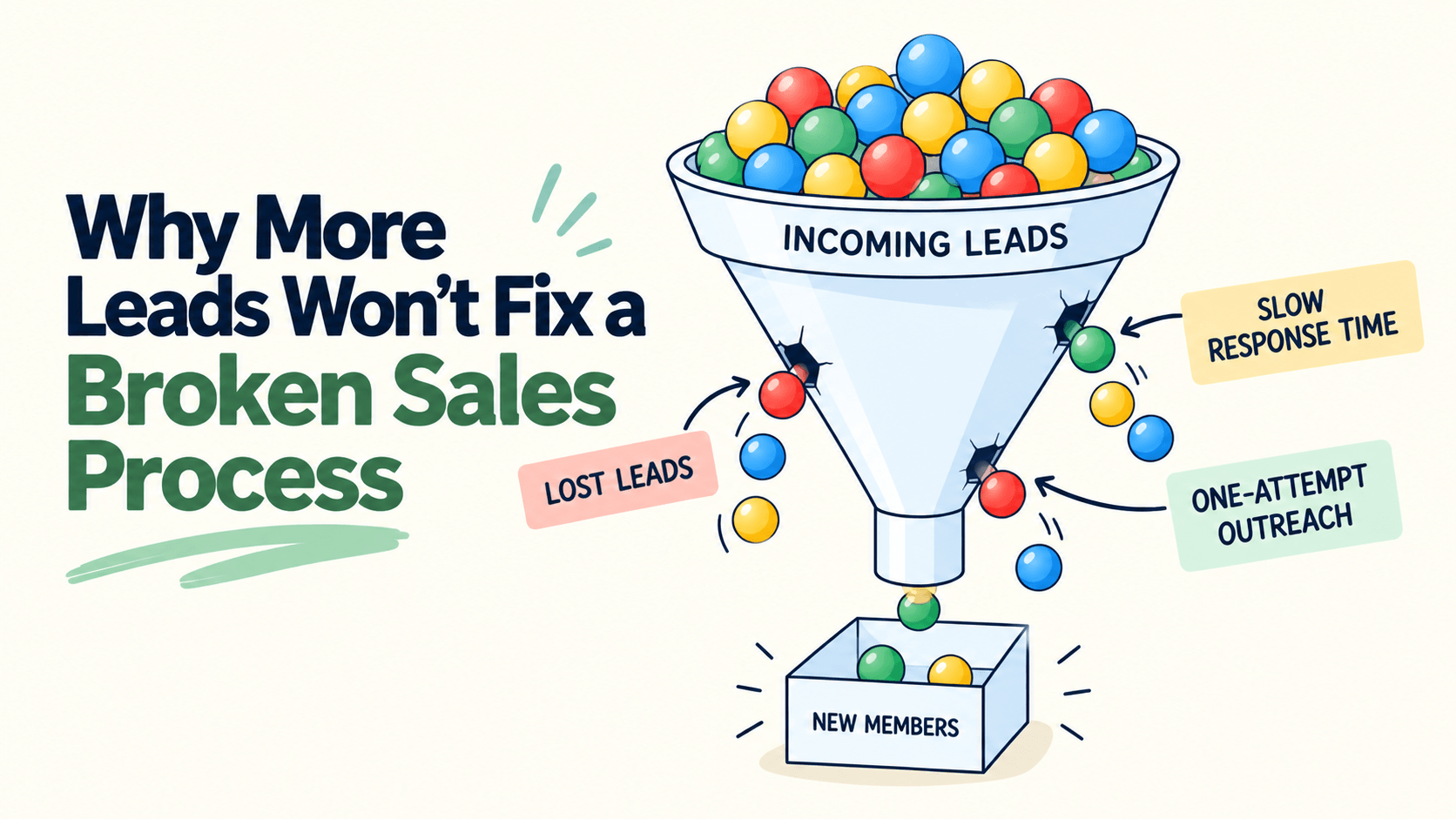
Why More Leads Won’t Fix a Broken Sales Process
TL;DR: More website traffic can create more opportunities for your studio, but traffic alone does not fill classes. Visitors first have to become leads, and those leads still have to be contacted, booked, shown up, and enrolled. Before increasing your ad spend or chasing more clicks, look at your entire funnel. The biggest opportunity may not be getting more people to your website. It may be converting more of the traffic and leads you already have.
Why are your classes still not full?
You did the hard part. You built a lead-generating website. People are finding you online. They are visiting your program pages, clicking around your website, and submitting forms. The phone rings. Trial requests land in your inbox.
And yet the same spots sit empty, class after class.
So you do what feels like the obvious next move: you aim for more traffic.
Bigger ad budget. More boosted posts. Another campaign. More SEO. More people landing on your website.
But here is the problem: website traffic is not the same thing as leads, and leads are not the same thing as members.
Traffic simply tells you that people are visiting your website. Those visitors still have to take an action before they become a lead, whether that is filling out a form, requesting a trial, booking an appointment, or calling your school.
And once they become a lead, your sales process has to take it from there.
The real funnel looks more like this:
Website Traffic → Leads → Contact → Appointment → Show → Enrollment
If any one of those stages is underperforming, simply adding more traffic at the top will not fix the problem.
It will just send more people into the same leaky funnel.
Key points for studio owners to consider
- Traffic and leads are not the same thing. Website traffic measures visitors. Leads are the visitors who actually take the next step.
- Your website has to convert traffic into leads. If plenty of people visit but very few inquire, getting more traffic may not be the first problem to solve.
- Response time matters once a lead comes in. Interest is highest when someone first reaches out.
- Contact rate shows whether your follow-up is working. A lead cannot book if you never actually connect.
- Appointment and show rates reveal what happens between interest and walking through your door.
- Close rate tells you how effectively those opportunities become paying members.
- Measure the entire funnel before you add more traffic. If one stage is leaking, increasing volume can multiply the problem.
Start with the traffic and leads you already have
It is tempting to reach for more traffic when classes have room to grow. But before you spend another dollar attracting new visitors, look at what is already happening on your website.
Start with a simple question:
Are people visiting your website?
If the answer is no, then traffic may genuinely be your problem. Your studio may need stronger search engine optimization, better local visibility, stronger content, or advertising that gets your business in front of more prospective members.
But if people are visiting your website, ask the next question:
Are those visitors becoming leads?
Imagine two martial arts schools each receive 1,000 website visitors in a month.
School A generates 20 leads.
School B generates 75.
They have the exact same amount of traffic, but dramatically different results.
School A could spend money bringing another thousand people to its website. Or it could first figure out why so many of its existing visitors are leaving without taking action.
Maybe the calls to action are buried.
Maybe the program pages do not clearly explain the value.
Maybe the contact form asks for too much information.
Maybe the mobile experience makes it difficult to take the next step.
Maybe there is no compelling trial offer.
A website should do more than attract visitors. It should give those visitors a clear path toward becoming leads.
Traffic creates opportunity. Conversion turns that opportunity into leads.
And once those leads come in, the next part of your funnel takes over.
The six numbers that tell you whether more traffic will actually help
Run these numbers over a normal month and you will have a much clearer picture of where prospective students are getting lost.
1. Website conversion rate
Start at the top.
Of all the people visiting your website, how many actually take the next step?
That might mean requesting information, booking a trial, filling out a form, calling your school, or claiming an introductory offer.
If traffic is healthy but leads are low, look at your website before you start spending more to attract visitors.
Your website should make it easy for someone to understand what you offer and what they should do next.
Strong calls to action, mobile-friendly pages, clear program information, simple forms, and strategically placed offers all help move a visitor from browsing to raising their hand.
2. Response time
Once a visitor becomes a lead, the clock starts.
A parent who requests information about kids martial arts may also be looking at other schools nearby. An adult searching for kickboxing may have several tabs open comparing programs.
The longer that inquiry sits unanswered, the more opportunity you give that person to continue searching.
Automated email and SMS marketing can immediately acknowledge an inquiry while your team follows up personally.
The goal is simple: keep the conversation moving while the prospect’s interest is still fresh.
3. Contact rate
This is the percentage of leads your team actually connects with.
A form submission does not guarantee someone will answer the first call.
They may be working. They may miss your voicemail. They may read your text and forget to respond.
That is why one attempt is not a follow-up strategy.
Your lead management process should make it easy to see who has been contacted, who still needs follow-up, and where each prospect stands.
If leads regularly disappear after one unanswered call or email, you may not have a lead-generation problem at all.
You may have a follow-up problem.
4. Appointment rate
Getting someone to say, “Yes, we’ll come try a class,” is the next checkpoint.
A prospect who has already submitted a form does not need another marketing pitch. They need a clear and easy next step.
If you are connecting with plenty of leads but very few are scheduling, look at what happens during that conversation.
Is scheduling easy?
Is your offer clear?
Are you answering the questions families need answered before they feel comfortable walking through the door?
The easier you make that next step, the less opportunity there is for a warm lead to disappear.
5. Show rate
A booked trial is progress, but it is not an enrollment.
Every studio owner knows the frustration of seeing a trial on the calendar only for nobody to walk through the door.
Sometimes people lose interest. But sometimes life simply happens.
They forget. A meeting runs late. Their child has practice. They cannot find the address five minutes before class.
Confirmations, reminder texts, and marketing automation can help close the gap between “We’ll be there Tuesday” and actually showing up Tuesday.
6. Close rate
This is where the entire funnel comes together.
The prospect found you.
Your website converted them into a lead.
Your team followed up.
They booked.
They showed up.
Now, did they enroll?
If trials consistently walk out the door without becoming members, more website traffic is unlikely to solve the problem.
Look at the trial experience itself. Look at how parents and students are greeted. Look at the enrollment conversation. Look at what happens when someone says, “Let me think about it.”
You worked hard to get that prospect this far.
Do not let the process end without giving them a clear next step.
What the leaks actually look like in a normal week
Numbers can feel abstract until you see what they look like in real life.
The website browser. A parent lands on your website after searching “kids karate near me.” She looks through three pages but cannot figure out how to schedule a trial. She leaves. You had the traffic, but you never got the lead.
The slow responder. A parent requests a trial Tuesday morning. Nobody follows up until Thursday. By then, she has already booked an introductory class somewhere else. You had the lead, but the follow-up came too late.
The one-and-done follow-up. A prospect submits a form while at work. You call once at 2:00 p.m. They do not answer. Nobody tries again. The lead was not bad. They were just busy.
The trial that never happens. You book a six-year-old’s first class. The family does not show up. They were interested, but the reminder never went out and life got in the way.
The near-miss. The trial goes great. The kid loves it. Mom is nodding along. But nobody clearly asks her to enroll. “We’ll think about it” becomes two weeks of silence.
Every one of these looks like a lost lead.
But every one happened at a completely different point in the funnel.
That is why knowing your numbers matters.
Advanced reporting gives you better visibility into what is happening inside your studio so you can make decisions based on the process rather than assumptions.
Every leak you patch makes the traffic and leads you already have more valuable.
When should you actually focus on more website traffic?
None of this means traffic is bad.
More of the right traffic can absolutely help your studio grow.
The order just matters.
If your website is converting visitors into leads, your team follows up consistently, appointments are being booked, prospects are showing up, and trials are becoming members, then increasing traffic gives a working system more opportunities to convert.
That is where strategies like search engine optimization, stronger program content, landing pages, and paid advertising become especially valuable.
But if 1,000 visitors come to your website and almost nobody converts, buying another 1,000 visitors does not address the underlying issue.
Likewise, if leads are coming in but nobody follows up with them, generating another 50 leads simply gives your team 50 more opportunities to miss.
Do not automatically assume more traffic is the answer. Find the bottleneck first.
How to audit your own funnel this week
You do not need to guess where the problem is.
Look at the last 30 days and follow prospective members through the funnel from beginning to end:
- Website traffic: How many people visited your website?
- Website leads: How many of those visitors took action?
- Response time: How quickly did your team follow up?
- Contact rate: How many leads did you actually connect with?
- Appointment rate: How many scheduled a trial or consultation?
- Show rate: How many actually showed up?
- Close rate: How many became members?
Then look for the biggest drop.
That is where you start.
If traffic is low, work on visibility.
If traffic is strong but leads are low, work on website conversion.
If leads are strong but contact is low, work on follow-up.
If appointments are strong but shows are low, work on reminders.
If shows are strong but enrollments are low, work on the trial and sales experience.
Fix the weakest point. Measure again. Then decide whether adding more traffic makes sense.
FAQs About Website Traffic, Leads, and Your Sales Process
What is website traffic?
Website traffic is simply the number of people visiting your website. Those visitors may find you through Google, social media, paid advertising, direct links, referrals, or other online sources.
Traffic creates opportunities for lead generation, but a website visitor does not become a lead until they take an action, such as submitting a form, requesting information, booking a trial, or calling your studio.
What is the difference between website traffic and leads?
Website traffic measures visitors. Leads are the people who take the next step and identify themselves as potential customers.
For example, if 1,000 people visit your website and 50 submit a trial form, you had 1,000 website visitors and generated 50 leads.
Both numbers matter because they tell you different things about your marketing.
How do I know if I need more website traffic?
Start by looking at how much traffic your website receives and what those visitors do once they arrive.
If very few prospective customers are reaching your website, increasing visibility through SEO, content, local search, or advertising may be necessary.
If you already have healthy traffic but visitors are not converting, focus on your website before spending money to attract more people.
Why am I getting website traffic but no leads?
Traffic without leads can indicate a conversion problem.
Your calls to action may be difficult to find, your forms may create too much friction, your program pages may not answer the right questions, or visitors may not understand what they should do next.
A website should be intentionally designed to move prospective students toward taking action, not simply give them information.
Why am I getting leads but not new members?
If leads are coming in but enrollments are not following, look further down your sales funnel.
How quickly are you responding? How many leads are you actually reaching? How many schedule? How many show up? How many enroll?
Your lead volume may be perfectly healthy while your sales process is losing opportunities somewhere between the inquiry and enrollment.
Should I increase my advertising if I want more students?
Advertising can help bring more prospective members into your funnel, but first make sure the funnel is working.
If your website converts visitors into leads and your sales process consistently moves those leads toward enrollment, increasing traffic can help create more opportunities.
If your funnel is leaking, increasing ad spend can also increase the number of opportunities you lose.
Fix the Funnel, Then Turn Up the Traffic
Website traffic matters.
Without visitors, your website has nobody to convert.
But traffic is only the beginning of the journey.
Your website needs to turn visitors into leads. Your follow-up needs to turn leads into conversations. Your sales process needs to turn conversations into appointments. Your experience needs to turn appointments into members.
Before assuming you need more traffic, follow the numbers all the way from the first website visit to enrollment.
You may discover that the fastest path to growth is not getting more people into your funnel.
It is getting more of the people already entering it all the way through.
Ready to Turn More Website Traffic Into Members?
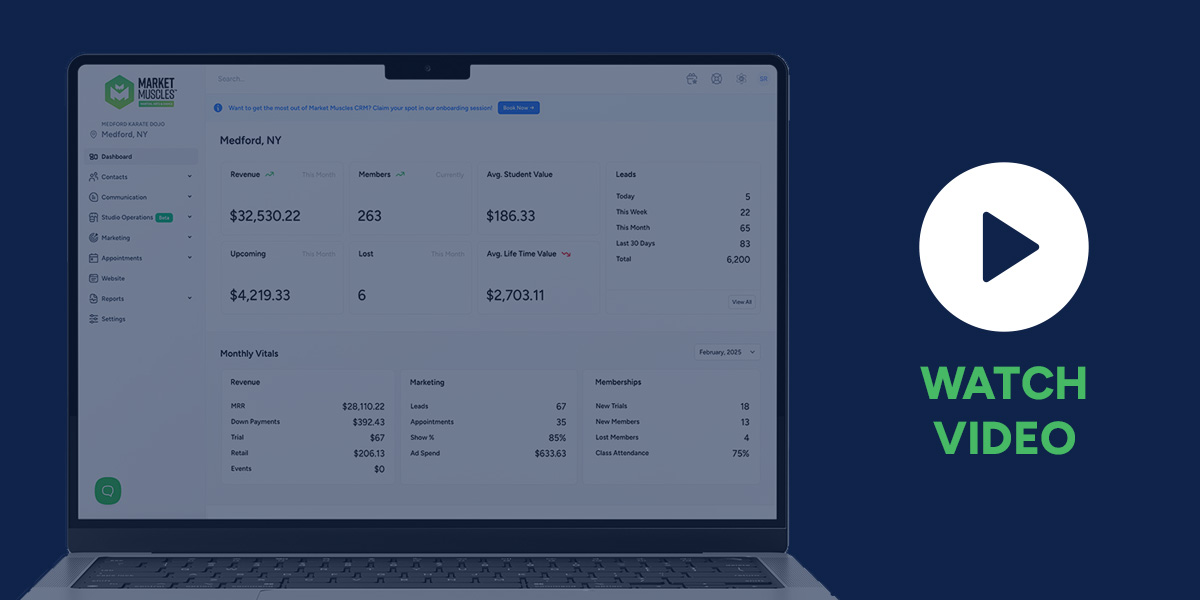
Market Muscles brings your website, lead generation, follow-up, and studio management together so you can see the bigger picture.
Our lead-generating websites are built to turn clicks into inquiries, while our studio software helps you manage leads, automate follow-up, schedule appointments, and keep opportunities moving.
Because the goal is not just more website traffic.
Let’s grow your studio.