The Studio Owner’s Guide to Understanding Website Analytics (Without Getting Overwhelmed)

TL;DR: You don’t need a marketing degree to understand your website analytics. By focusing on just a handful of key metrics — like where your visitors come from, which pages they visit, and how many turn into leads — you can make smarter decisions that actually grow your studio. This guide breaks it all down in plain English.
Why Do So Many Studio Owners Avoid Their Website Analytics?
You built your studio from the ground up. You know how to run classes, manage staff, keep students coming back, and grow your community. But the moment someone says “Google Analytics” or “bounce rate,” your eyes glaze over. You’re not alone.
Most martial arts, dance, and fitness studio owners didn’t get into this business to stare at dashboards full of numbers. And the truth is, the analytics world has made things unnecessarily complicated. There are hundreds of metrics you could track — but only a handful that actually matter for a local studio trying to fill classes and keep students enrolled.
The good news? Once you know what to look at (and what to ignore), website analytics become one of the most powerful tools in your marketing toolbox. Let’s strip away the jargon and focus on what actually moves the needle for your business.
Key points for studio owners to consider:
- You only need 5–7 key metrics — not the hundreds your analytics dashboard throws at you. Focus on what drives enrollments.
- Traffic sources tell you where to invest — knowing whether leads come from Google, social media, or referrals helps you spend smarter.
- Your top pages reveal what prospects care about — if everyone visits your schedule page but nobody fills out a form, that’s a clue.
- Conversion rate is the metric that pays the bills — all the traffic in the world means nothing if visitors don’t become leads.
- Mobile performance is non-negotiable — most of your prospects are finding you on their phones.
- Check monthly, not daily — analytics are best viewed as trends over time, not daily obsessions.
The Only Metrics That Actually Matter for Your Studio
Open up any analytics platform and you’ll see dozens of charts, graphs, and numbers competing for your attention. Here’s a secret: most of them don’t matter for a local studio. Let’s zero in on the ones that do.
1. Total Website Visitors (Sessions)
This is the simplest metric: how many people are visiting your website? Think of it as foot traffic for your online presence. If this number is growing month over month, your SEO and marketing efforts are working. If it’s flat or declining, something needs attention.
What to look for: A steady upward trend over 3–6 months. Don’t panic over a single slow week — seasonal dips happen, especially around holidays and summer breaks.
2. Traffic Sources (Where Visitors Come From)
Not all traffic is created equal. Your analytics will break visitors into categories like:
- Organic Search — people who found you through Google or another search engine
- Direct — people who typed your URL directly or used a bookmark
- Social — visitors from Facebook, Instagram, TikTok, etc.
- Referral — visitors who clicked a link on another website
- Paid — traffic from Google Ads, Facebook Ads, or other paid campaigns
Why this matters: If 80% of your traffic is organic, your SEO strategy is paying off. If paid traffic converts better than social, you know where to put your ad dollars. This one metric alone can save you thousands in wasted marketing spend.
3. Top Pages (What People Are Looking At)
Which pages on your site get the most visits? For most studios, the top pages are typically the homepage, schedule/class page, reviews page, and about/instructors page. This tells you exactly what prospects care about when they’re evaluating your studio.
Pro tip: If your lead-generating website has a “Programs” page getting tons of traffic but few form submissions, it might need a stronger call-to-action or a simpler way to sign up for a trial class.
4. Bounce Rate
Bounce rate measures the percentage of visitors who land on a page and leave without clicking anything else. A high bounce rate (above 70%) on your homepage could mean your site isn’t immediately engaging, loads too slowly, or doesn’t match what the visitor expected to find.
Keep in mind: A high bounce rate on a blog post is normal — someone reads the article and leaves. But a high bounce rate on your main landing pages or homepage is a red flag worth investigating.
5. Conversion Rate
This is the big one. Your conversion rate measures the percentage of website visitors who take a desired action — filling out a contact form, signing up for a trial class, calling your studio, or booking an appointment.
For local service businesses like martial arts schools and dance studios, a good website conversion rate typically falls between 3–8%. If you’re below that, your site might have a traffic quality problem (wrong people visiting) or a user experience problem (right people visiting but getting confused or frustrated).
If you only track one metric, make it your conversion rate. It’s the direct line between your website and your revenue.
6. Mobile vs. Desktop Split
Check what percentage of your visitors are on mobile devices. For most studios, it’s 60–75% mobile. If your website doesn’t look great and load fast on a phone, you’re losing the majority of your potential leads before they ever see your class schedule.
7. Average Session Duration
How long do people spend on your site? If the average visit is under 30 seconds, visitors aren’t finding what they need. If it’s 2–3 minutes, they’re genuinely exploring your programs, reading about your instructors, and considering signing up. Longer sessions usually correlate with higher conversion rates.
How to Actually Check Your Analytics (The Simple Way)
You don’t need to become a data analyst. Here’s a simple routine that takes less than 15 minutes a month:
- Log in once a month — set a recurring calendar reminder. The first Monday of every month works well.
- Compare to last month — most analytics platforms let you view month-over-month comparisons. Look for the direction of the trend, not the exact numbers.
- Check your top 3 metrics — total visitors, traffic sources, and conversion rate. If all three are trending up, you’re in great shape.
- Note anything unusual — a sudden spike or drop usually has an explanation (a new blog post went live, you ran a Facebook ad, a holiday weekend, etc.).
- Write down one action item — based on what you see, pick one thing to improve next month. Maybe it’s writing a new blog post, updating your reviews page, or investing more in the traffic source that’s converting best.
That’s it. Fifteen minutes, once a month, and you’ll know more about your online marketing performance than most studio owners ever will.
Common Analytics Mistakes Studio Owners Make
Even when studio owners do check their analytics, a few common traps can lead them astray:
Obsessing Over Vanity Metrics
Total page views and social media followers feel good, but they don’t pay the bills. A studio with 500 monthly visitors and a 7% conversion rate is outperforming one with 5,000 visitors and a 0.2% conversion rate. Always tie metrics back to leads and enrollments.
Checking Too Often
Daily analytics checking leads to anxiety and knee-jerk decisions. Data needs time to tell a story. Weekly glances are fine if you’re running an active campaign, but monthly reviews are the sweet spot for ongoing strategy.
Ignoring Local SEO Data
Your Google Business Profile has its own analytics — and for a local studio, these are just as important as your website data. How many people found you in Google Maps? How many clicked for directions or called directly? These “near me” searches are some of your highest-intent leads. Make sure your local SEO strategy is working.
Not Connecting the Dots to Real Enrollment
Analytics tell you what’s happening on your website, but you also need to connect that to what’s happening at the front desk. If your website leads are up but enrollments are flat, the problem might be in your follow-up process, not your website. A good lead management system helps bridge that gap.
What About Google Analytics 4? Is It Worth Learning?
Google Analytics 4 (GA4) is Google’s current analytics platform, and it can be overwhelming. The interface isn’t particularly intuitive, and it was designed more for e-commerce businesses than local service providers.
Here’s the honest truth: GA4 is powerful but overkill for most studio owners. If you have a marketing team or agency managing your website, they should be the ones digging into GA4 and presenting you with a simple monthly summary. If you’re doing it yourself, focus on the “Reports” section and look at the metrics we covered above.
Better yet, work with a website partner that builds reporting and analytics directly into your dashboard so you don’t have to wrestle with GA4 at all.
How to Turn Analytics Into Actual Growth
Data without action is just numbers on a screen. Here’s how to turn what you learn into real results:
- Low traffic? Invest in SEO and consistent blogging. Make sure your site is optimized for answer engine optimization (AEO) so it shows up in AI-powered search results too.
- Traffic is good but conversions are low? Review your calls-to-action, simplify your forms, and make sure your trial offer is compelling and easy to find.
- Most traffic is mobile but your site isn’t mobile-friendly? This is your top priority — a slow, clunky mobile experience is actively costing you students.
- One traffic source dominates? Diversify. If 90% of your leads come from Google Ads, what happens when you pause the campaign? Build organic search and email/SMS marketing as backup channels.
- Blog posts getting traffic but not leads? Add clear calls-to-action within your content. Every blog post should have a path to becoming a lead.
The Market Muscles Approach to Studio Analytics
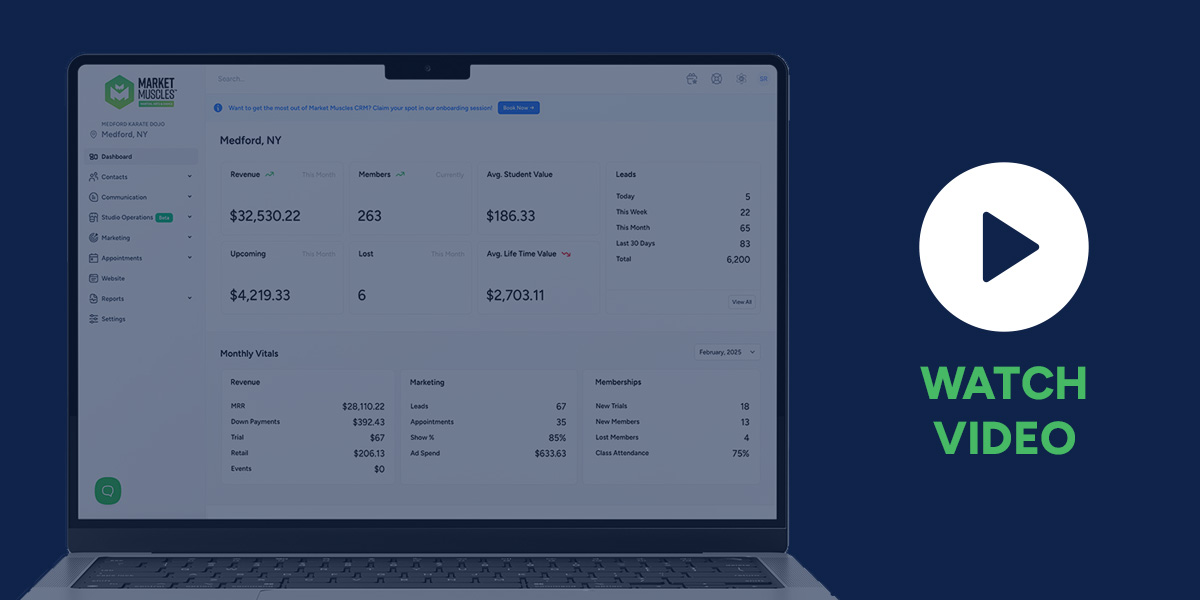
At Market Muscles, we believe studio owners should spend their time teaching classes and growing their community — not deciphering complicated analytics dashboards. That’s why our platform is built to surface the metrics that matter in a way that’s easy to understand and act on.
Every Market Muscles website is designed as a lead-generating machine from day one, with built-in conversion tracking, lead management, and advanced reporting that connects your website performance directly to your enrollment pipeline. You can see at a glance what’s working, what needs attention, and where your next students are coming from..
FAQs About Website Analytics for Studio Owners
What is the most important website metric for a studio owner?
Conversion rate. It measures how many website visitors actually take action — like filling out a form or signing up for a trial. All the traffic in the world doesn’t matter if it’s not turning into real leads for your studio.
How often should I check my website analytics?
Once a month is ideal for most studio owners. Set a recurring reminder and spend 15 minutes reviewing your key metrics. If you’re running a specific campaign (like a back-to-school promotion), weekly check-ins during that period are fine.
What’s a good conversion rate for a studio website?
For local service businesses like martial arts schools and dance studios, a conversion rate between 3–8% is considered strong. If you’re below 2%, your site likely needs improvements to its calls-to-action, page speed, or overall user experience.
What’s the difference between a session and a page view?
A session is one visit to your website (a person arrives, browses around, and leaves). A page view is counted each time any page loads. One session can have multiple page views. Sessions are generally more useful for understanding how many people are visiting your site.
How do I know if my SEO is working?
Look at your organic traffic trend over 3–6 months. If the number of visitors coming from search engines is growing, your SEO strategy is working. You can also check your local visibility by searching terms like “martial arts near me” or “dance classes in [your city]” in an incognito browser and seeing where your school appears in Google Search and Maps.
Stop Guessing — Start Growing With Confidence
Website analytics aren’t scary — they’re simply a window into how your online presence is performing. You don’t need to understand every chart, graph, or data point. You just need to know the handful of metrics that connect your website to real-world student growth.
Start small. Check your numbers once a month. Pick one thing to improve. Over time, those small, data-informed decisions compound into real, measurable growth for your studio.
And if you’d rather have a team in your corner that understands what the data means and can help guide your strategy, that’s exactly what we do. We combine proven marketing tactics with industry expertise to help you make informed decisions and identify opportunities for growth.
Book a demo and see how Market Muscles makes analytics easier to understand—so you can focus on what you do best.
Ready to take the next step for your studio?
Book a free demo to see how Market Muscles can help you get more leads, streamline your day-to-day, and grow without the overwhelm. No pressure. Just real solutions built for studio owners like you.