The Multi-Location Website Decision Matrix: One Website or Many?
TL;DR: If you run a martial arts school, dance studio, or fitness business with more than one location, your website strategy can make or break your local search rankings. The answer isn’t always “one website” or “separate websites” — it depends on your programs, geography, branding, and growth goals. This guide gives you a clear decision framework so you can stop guessing and start dominating Google in every zip code you serve.
One Website or Five — Which Strategy Actually Gets You More Students?
It’s one of the most common questions we hear from multi-location studio owners: “Should I have one website for all my locations, or should each location get its own?”
The honest answer? It depends. And getting it wrong can cost you thousands of dollars in lost leads — or years of wasted SEO effort building authority on a domain that’s working against you.
We recently spoke with a franchise owner running five BJJ locations across Texas. He’d been with the same website provider for over 20 years and was still struggling to generate quality leads online. His managers were dropping the ball on follow-ups, and his web presence wasn’t differentiating any of his locations from the competition. Sound familiar?
Whether you run two locations in the same city or ten across a state, this decision matrix will help you choose the right website architecture — and avoid the most expensive mistakes.
Key points for multi-location studio owners to consider:
- Geography matters most. Two locations in the same zip code need a different strategy than two locations 100 miles apart.
- Program differentiation drives the decision. If your locations offer different programs (BJJ vs. Taekwondo vs. kids-only), separate sites almost always win.
- Domain authority is your hidden asset. Every page, every blog post, every backlink builds authority — splitting too early can reset the clock.
- Google rewards local relevance. A single site can rank in multiple cities, but only if each location has its own dedicated pages with unique, localized content.
- AI search engines are changing the game. School owners are already getting leads from ChatGPT and Google Gemini. Your content strategy needs to feed these AI engines, not just traditional search.
The Decision Matrix: 4 Questions That Determine Your Website Strategy
Before you decide on one site versus many, walk through these four questions. Your answers will point you toward the right architecture.
Question 1: How far apart are your locations?
This is the single biggest factor. Here’s the rule of thumb:
- Same city or within 10 miles: One website with dedicated location pages is usually the best approach. You’ll build stronger domain authority with a single domain, and Google can still distinguish your locations through separate Google Business Profiles and location-specific landing pages.
- Different cities or 20+ miles apart: Separate websites start making more sense. Each site can target its own local keywords, build its own backlink profile from local businesses and organizations, and rank independently in its city’s search results.
- Different states or regions: Separate websites are almost always the right call. A site optimized for “BJJ in Prosper, TX” and another for “BJJ in McKinney, TX” will each rank better than one site trying to cover both.
A franchise owner told us: “I wouldn’t mind paying for 10 websites if you dominate Google.” That’s the right mindset — but only if the strategy supports it.
Question 2: Do your locations offer the same programs?
If every location teaches the same curriculum under the same brand, a single website with location subpages is efficient and effective. But if your locations have evolved differently — maybe one focuses on competition BJJ while another is family-oriented kids martial arts — separate sites let each location tell its own story.
Consider this: a prospect searching for “kids karate near me” and a prospect searching for “competition BJJ training” have completely different intent. If your locations serve these different markets, separate websites let you tailor the messaging, imagery, and calls-to-action for each audience.
Question 3: How strong is your current domain authority?
Domain authority is a score (roughly 1-100) that reflects how much trust and credibility your website has earned in Google’s eyes. It’s built over time through quality content, backlinks from other websites, and consistent activity.
If you’ve been on the same domain for 5, 10, or even 20 years, you may have significant domain authority that you don’t want to throw away. Starting a brand-new domain for each location means starting from zero — no authority, no backlink history, no indexed content.
The smart move: Check your domain authority before making changes. If it’s strong, consider keeping the primary domain and adding location-specific subfolders (e.g., yourdomain.com/prosper/ and yourdomain.com/mckinney/). This lets every location benefit from the parent domain’s authority while still targeting local keywords.
Question 4: What’s your growth trajectory?
If you’re planning to open more locations in the next 1-2 years, build your website architecture to scale. A single well-structured site with a location hub page and individual location pages can accommodate growth without spinning up new domains every time. But if each new location will be a semi-independent franchise with its own branding, separate sites give each operator autonomy over their online presence.
The Three Website Architectures for Multi-Location Studios
Based on your answers above, one of these three approaches will fit best:
Architecture 1: Single Website with Location Pages
Best for: 2-4 locations in the same metro area, same programs, same brand.
You maintain one domain with dedicated pages for each location. Each page has its own address, phone number, map embed, staff bios, class schedule, and unique content. All locations benefit from the domain’s collective authority. Your blog content, backlinks, and answer engine optimization efforts compound across the whole site.
Pros:
- Strongest domain authority (all SEO efforts build on one domain)
- Easier to manage and update
- Lower cost (one website vs. multiple)
- Blog content ranks for all locations
Cons:
- Harder to differentiate locations with unique branding
- Can feel generic if locations serve very different markets
- Local ranking can suffer if location pages aren’t well-optimized
Architecture 2: Separate Websites Per Location
Best for: Locations in different cities/states, different programs, or semi-independent franchises.
Each location gets its own domain (or subdomain) with a fully customized site. This maximizes local relevance and lets each site target its specific market without competing against sibling locations.
Pros:
- Maximum local SEO targeting per location
- Complete branding control for each location
- No dilution — each site speaks directly to its community
- Individual operators can manage their own content
Cons:
- Higher cost (multiple website subscriptions)
- SEO effort is split — each domain builds authority independently
- More content to create and maintain
- Blogging effort must be duplicated or distributed
Architecture 3: Hybrid — Hub Site + Location Microsites
Best for: Growing franchises with 5+ locations that need brand consistency and local autonomy.
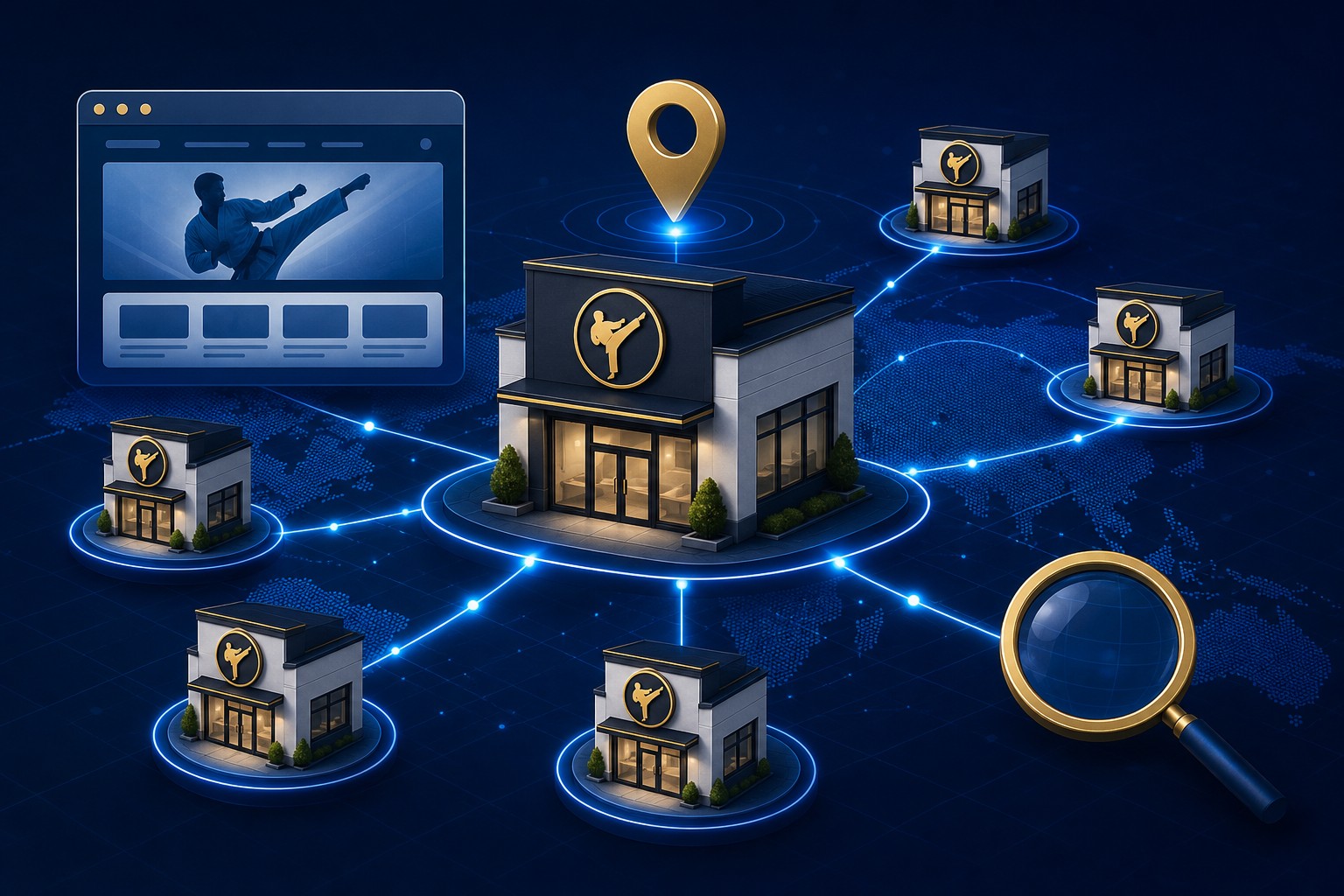
You maintain a primary brand website that serves as the hub — with overview pages, the blog, and corporate information. Each location also has its own microsite (or subdomain) for local SEO. The hub links to all location sites, and each location site links back, creating a powerful internal link network.
Pros:
- Brand consistency from the hub site
- Local optimization from individual sites
- Cross-linking boosts authority for everyone
- Scalable as you add locations
Cons:
- Most complex to set up and manage
- Highest cost
- Requires deliberate content strategy to avoid duplicate content issues
The Blogging Multiplier: Why Content Is Your Secret Weapon
Regardless of which architecture you choose, blogging is the single most underrated growth lever for multi-location studios. Every blog post is a new page that Google can index, a new opportunity to rank for a long-tail keyword, and — increasingly — a new answer that AI search engines like ChatGPT and Gemini can surface when someone asks about martial arts in your area.
One franchise owner we spoke with was surprised to learn that prospects were finding his school through AI searches: “I just got a lead, and when I asked how they heard about us, they said Gemini.”
This is happening right now, and it’s only going to accelerate. The studios that invest in consistent, high-quality content — even just one blog post a week — are the ones these AI engines will recommend. And with AI writing tools available today, creating that content takes minutes, not hours.
For multi-location owners, the key is making sure each location benefits from your content. On a single-site architecture, every blog post strengthens the whole domain. On separate sites, you’ll need to create location-specific content for each — or repurpose core content with local angles.
Don’t Forget Google Business Profiles
No matter which website architecture you choose, every location needs its own Google Business Profile (GBP). This is non-negotiable. Your GBP drives the local map pack rankings that generate the majority of “near me” searches, and each profile should link to its corresponding location page or website.
Make sure each GBP has:
- Accurate name, address, and phone number (NAP consistency is critical)
- Location-specific photos of the actual facility, instructors, and students
- Regular posts and updates
- Active review management — responding to every review, positive or negative
- A direct link to the correct location page on your website
The Branding Question: Standing Out in a Crowded Market
With martial arts — especially BJJ — exploding in popularity, competition is fiercer than ever. Multiple schools in the same area often end up with similar color schemes (red, white, and black), similar stock photography, and similar messaging.
Your website is your first impression. Multi-location owners have a unique opportunity to differentiate each location’s brand while maintaining a cohesive parent identity. Think about:
- Unique photography: Use real photos of each location’s facility, staff, and students. No stock photos.
- Color differentiation: If competition in one area all uses red and black, consider a bold alternative — teal and gold, or charcoal and orange.
- Location-specific messaging: Highlight what makes each location special. Competition training? Family programs? A legendary instructor?
- Community ties: Reference local landmarks, events, and partnerships. This signals to both Google and prospects that you’re truly local.
How Market Muscles Approaches Multi-Location Websites
At Market Muscles, we’ve helped hundreds of martial arts schools and dance studios build lead-generating websites — including multi-location operations from 2 to 10+ locations. We don’t believe in one-size-fits-all solutions.
When a multi-location owner comes to us, we start with this exact decision matrix. We talk through geography, program mix, domain history, growth plans, and budget to recommend the right architecture. Then we build it with SEO baked in from day one, including clean site structure, local SEO best practices, schema markup, and a content strategy designed to support visibility across traditional search engines and AI answer engines.
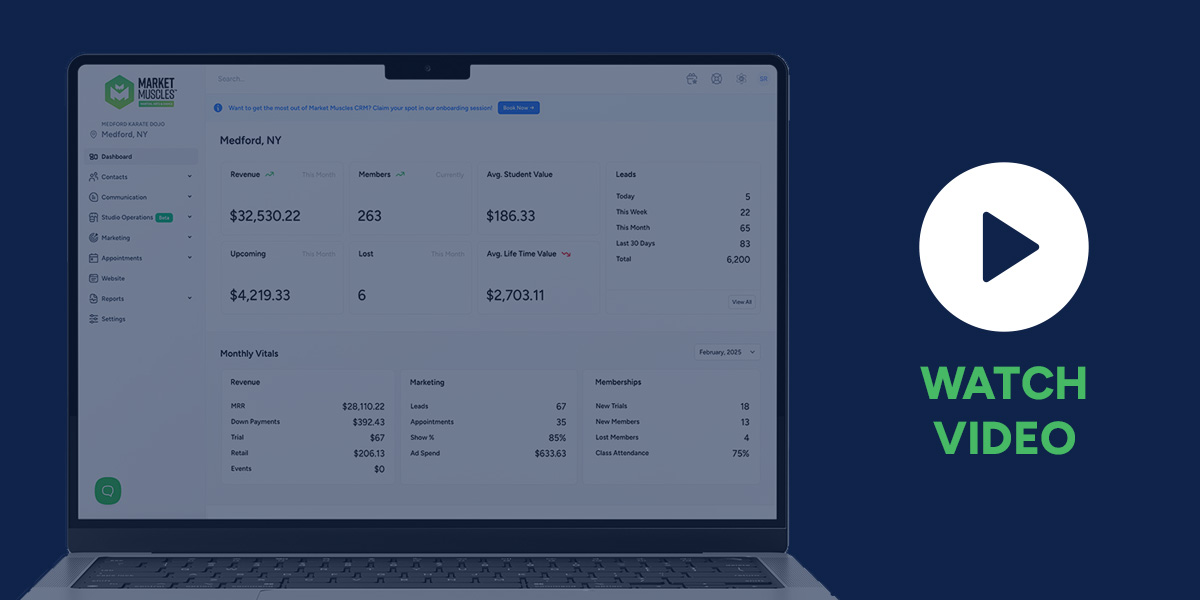
And because every Market Muscles website is connected to our lead management CRM, you can track exactly which location is generating leads, automate follow-ups with email and SMS marketing, and make sure no prospect falls through the cracks — even if you’re managing five locations from your phone.
FAQs About Multi-Location Websites
Can one website rank in multiple cities?
Yes. In many cases, a single website can successfully rank across multiple cities, especially if the locations operate under the same brand and have been established that way for a long time. The key is having dedicated location pages for each studio that include unique content, local keywords, accurate contact information, photos, schedules, and other location specific details.
Will splitting my website into separate domains hurt my SEO?
It can, at least initially. If your current domain has strong authority, splitting means each new domain starts from scratch. The long-term benefit depends on how different your locations’ markets are. If they’re in the same city, keep one domain. If they’re in different cities, the local ranking benefits of separate domains typically outweigh the short-term authority loss.
How do I know if my current website setup is hurting my local rankings?
Common signs include low visibility in Google Maps, difficulty ranking in nearby cities, duplicate content across location pages, or inconsistent lead flow between locations.
What is domain authority and why does it matter?
Domain authority reflects the trust and credibility your website has built over time. Strong authority can help your pages rank higher in search results and make it easier to expand into additional markets.
How do AI search engines like ChatGPT and Gemini decide which schools to recommend?
AI engines pull from indexed web content, reviews, Google Business Profiles, and structured data. The schools with the most comprehensive, up-to-date, and locally relevant content are the ones that get recommended. Blogging consistently, maintaining accurate business listings, and having a well-structured website all contribute to your visibility in AI-powered search results.
What if I start with one website and want to split later?
This is a common path. Start with a single domain to build authority, then split when individual locations have enough content and local presence to stand on their own. Just plan the transition carefully — set up proper 301 redirects from old location pages to new domains so you don’t lose existing rankings.
Stop Guessing — Build the Right Foundation for Every Location
Your website architecture isn’t just a technical decision — it’s a business strategy decision that affects how many leads each location generates, how much you spend on marketing, and how fast you can grow. The right choice depends on your specific situation, and now you have the framework to make it confidently.
If you’re running multiple locations and aren’t sure whether your current website setup is helping or hurting you, we’d love to take a look. Our team works with multi-location owners every day and can give you a clear recommendation in a single conversation.
Book a demo and let’s map out the right website strategy for every location in your network.
Ready to take the next step for your studio?
Book a free demo to see how Market Muscles can help you get more leads, streamline your day-to-day, and grow without the overwhelm. No pressure. Just real solutions built for studio owners like you.